
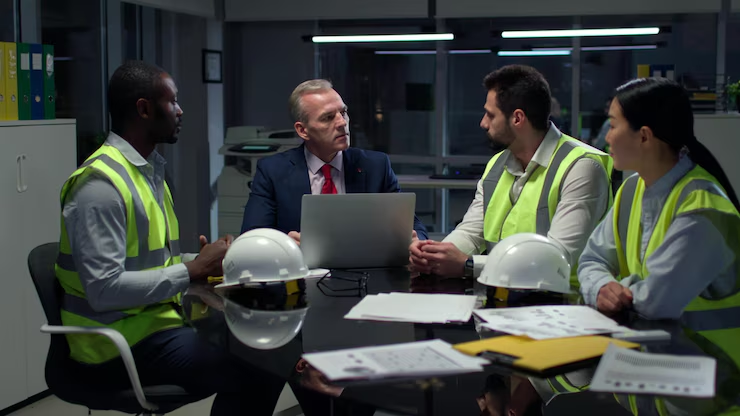
The Indispensable Architect of Assurance: The Role Of Lawyers in Managing Construction Risks
Construction projects are monumental undertakings. From towering skyscrapers to intricate infrastructure networks, they represent the convergence of ambition, engineering prowess, and significant capital investment. Yet, beneath the blueprints and the hum of machinery lies a complex web of inherent risks – financial, operational, environmental, and, crucially, legal. These risks, if unaddressed, can lead to costly delays, budget overruns, reputational damage, and even project abandonment.
In this high-stakes environment, one profession stands as the indispensable architect of assurance: the lawyer. Far from being mere reactive responders to disputes, construction lawyers play a proactive, strategic, and often preventative role in navigating the treacherous landscape of project risks. They are not just legal advisors; they are integrated partners, guiding stakeholders through every phase, from conception to completion and beyond, ensuring legal soundness and safeguarding commercial interests.
Think About It: Imagine you’re about to embark on a multi-million-dollar construction project. What are your immediate concerns? Beyond the obvious practicalities of materials and labor, do legal risks feature prominently in your initial thoughts? Why or why not?
Understanding the Landscape of Risk in Construction
Before delving into the lawyer’s specific contributions, it’s essential to grasp the myriad risks inherent in construction. These aren’t static threats but dynamic challenges that can emerge at any point.
-
Financial and Payment Risks:
- Cash Flow Issues: Delays in payments from owners, slow processing, or disputes over payment applications can cripple a contractor’s finances.
- Cost Overruns: Unforeseen site conditions, material price fluctuations, labor cost increases, or design changes can push budgets past their limits.
- Insolvency: The financial distress or bankruptcy of any party (owner, contractor, subcontractor, supplier) can have a cascading effect across the project.
- Funding Withdrawal: Lenders may withdraw financing if project milestones are not met or if risks become too high.
- What if: You’re a subcontractor, and the main contractor habitually delays payments. What legal recourse do you have, and how could your contract have better protected you?
-
Contractual and Commercial Risks:
- Ambiguous or Incomplete Contracts: Vague language regarding scope of work, responsibilities, timelines, or deliverables can lead to misunderstandings and disputes.
- Scope Creep/Changes: Uncontrolled additions or alterations to the project scope without proper documentation and agreement can lead to significant cost and time impacts.
- Unfair Risk Allocation: Contracts that unfairly burden one party with risks they cannot control or mitigate are recipes for conflict.
- Lack of Clear Communication Protocols: Misinformation or delayed information flow among stakeholders can lead to errors and disputes.
-
Operational and Project Management Risks:
- Delays and Disruptions: Weather, unforeseen ground conditions, labor shortages, equipment breakdowns, permitting delays, or supply chain issues can derail schedules.
- Poor Workmanship/Defects: Substandard work or defective materials can lead to rework, safety hazards, and significant liability.
- Coordination Failures: Lack of synchronization between different trades, design teams, or contractors can lead to inefficiencies and clashes.
- Project Documentation Deficiencies: Inadequate record-keeping, missing permits, or unapproved drawings can weaken a party’s position in a dispute.
-
Regulatory and Compliance Risks:
- Building Code Violations: Non-compliance with local, national, or international building codes can result in fines, stop-work orders, or legal action.
- Environmental Regulations: Violations related to waste disposal, pollution, or protected areas can incur severe penalties and reputational damage.
- Health and Safety Breaches: Accidents on site due to inadequate safety measures can lead to injuries, fatalities, regulatory investigations, and criminal charges.
- Permitting and Zoning Issues: Delays or denials in obtaining necessary permits can halt a project indefinitely.
-
Legal and Liability Risks:
- Litigation and Arbitration: Formal disputes are costly, time-consuming, and can severely impact project progress and profitability.
- Third-Party Claims: Injuries to the public, damage to adjacent properties, or nuisance claims can result in substantial liability.
- Professional Negligence: Claims against architects, engineers, or project managers for errors or omissions in their professional duties.
- Insurance Gaps: Insufficient or inappropriate insurance coverage can leave parties exposed to significant financial losses when risks materialize.
The Proactive Sentinel: Lawyers in Pre-Construction Risk Management
The most effective risk management begins long before the first shovel breaks ground. Here, the lawyer acts as a proactive sentinel, meticulously laying the legal groundwork to prevent future problems.
-
Strategic Procurement and Project Structuring Advice:
- Before contracts are even drafted, lawyers advise on the optimal procurement strategy (e.g., Design-Bid-Build, Design-Build, Construction Management at Risk, EPC). Each structure has different risk allocation implications, and a lawyer can guide clients towards the model that best suits their risk appetite and project complexity.
- They help in structuring special purpose vehicles (SPVs) or joint ventures, outlining the legal relationships, responsibilities, and liabilities among the collaborating entities.
- Interactive Question: If you were an owner, would you prefer a contract that transfers most of the risk to the contractor, even if it means a higher initial bid, or one that shares risk more equitably? Discuss the pros and cons from a legal perspective.
-
Due Diligence and Risk Identification:
- Lawyers conduct thorough legal due diligence on project sites, land titles, existing easements, environmental assessments, and regulatory frameworks. This uncovers potential legal impediments or hidden liabilities before significant investment is made.
- They work with technical consultants to understand potential geotechnical issues, hazardous materials, or historical preservation requirements that could lead to legal complications.
- Scenario: Your due diligence reveals that a proposed site for a new factory is adjacent to a wetland. What are the immediate legal concerns, and how would a lawyer help mitigate this risk?
-
Masterful Contract Drafting and Negotiation:
- This is arguably the most critical pre-construction role. A well-drafted contract is the cornerstone of effective risk management. Lawyers:
- Clearly Define Scope of Work and Deliverables: They ensure precision in describing what is to be built, the quality standards, and the required outcomes, minimizing ambiguity.
- Allocate Risks Fairly and Clearly: This involves careful negotiation of clauses relating to unforeseen site conditions, force majeure events, changes in law, and material price fluctuations. The principle is generally to allocate risks to the party best able to control and manage them.
- Establish Robust Payment Terms: Including clear payment schedules, conditions for progress payments, mechanisms for valuing variations, and provisions for dealing with delayed payments (e.g., interest, suspension rights).
- Incorporate Change Management Procedures: Defining how changes to the scope, schedule, or cost will be proposed, reviewed, approved, and documented to avoid “scope creep” and disputes.
- Include Comprehensive Dispute Resolution Clauses: Specifying the preferred methods for resolving disputes (e.g., negotiation, mediation, adjudication, arbitration, litigation) and the processes for each, aiming for efficient resolution.
- Define Extension of Time (EOT) and Delay Damages: Establishing clear mechanisms for granting time extensions for excusable delays and specifying liquidated damages for delays caused by the contractor.
- Address Indemnities and Liabilities: Clearly outlining the extent to which parties will indemnify each other for losses and capping liabilities where appropriate and legally permissible.
- Incorporate Insurance Requirements: Specifying the types and levels of insurance required from all parties (e.g., C.A.R., professional indemnity, public liability) to ensure adequate coverage for various risks.
- Handle Termination Clauses: Detailing the conditions under which a contract can be terminated by either party, including procedures and consequences.
- Consider “Rise and Fall” Clauses: Especially in volatile economic climates (like Nigeria’s, where inflation is a concern), lawyers might incorporate clauses that allow for contract price adjustments based on material and labor cost indices.
- Think About It: Beyond the legal jargon, what makes a contract truly “fair” in the context of construction? Is it simply about equal distribution of risk, or something more nuanced?
- This is arguably the most critical pre-construction role. A well-drafted contract is the cornerstone of effective risk management. Lawyers:
-
Regulatory Compliance and Permitting Strategy:
- Lawyers advise on the complex web of local, state, and federal regulations, including zoning laws, environmental impact assessments, building codes, health and safety standards, and labor laws.
- They assist in identifying, securing, and expediting necessary permits and approvals, anticipating potential bureaucratic hurdles and developing strategies to overcome them.
- They ensure the project’s design and execution plan align with all legal requirements, mitigating the risk of fines, stop-work orders, or legal challenges from regulatory bodies or the public.
The Vigilant Guardian: Lawyers in During-Construction Risk Mitigation
Once construction commences, the lawyer’s role shifts from foundational planning to active monitoring and strategic intervention.
-
Contract Administration and Compliance Monitoring:
- Lawyers guide project teams on the proper administration of contracts, ensuring that all parties adhere to their contractual obligations. This includes advising on notice requirements, documentation protocols, and procedural steps for claims.
- They help interpret complex contract clauses as issues arise, providing timely legal opinions to prevent minor disagreements from escalating into major disputes.
- Interactive Scenario: A contractor informs the owner that they will be delayed due to a sudden shortage of a critical imported material. As the owner’s legal advisor, what’s the first thing you’d check in the contract, and what advice would you give regarding documentation?
-
Change Order Management:
- Changes are almost inevitable in construction. Lawyers ensure that all change orders are properly documented, valued, and approved in accordance with contractual procedures. They advise on the legal implications of proposed changes, negotiating terms to protect their client’s interests.
- They help differentiate between legitimate variations and potential “scope creep” or attempts to shift responsibility.
-
Claims Management and Avoidance:
- When issues arise that could lead to claims (e.g., delays, disruptions, defects, unforeseen conditions), lawyers play a crucial role in managing the process.
- They advise on the proper procedures for issuing notices, compiling supporting documentation, and formulating claims or defenses.
- Their goal is often to resolve potential claims informally through negotiation before they escalate into formal disputes, preserving project momentum and relationships.
- Think About It: Why is meticulous documentation so critical in construction, especially when a claim is looming? How can technology assist in this?
-
Health, Safety, and Environmental (HSE) Compliance:
- Lawyers advise on the evolving landscape of HSE regulations, helping clients implement robust compliance programs.
- In the event of an incident (e.g., accident, environmental spill), they provide immediate legal counsel, manage investigations, and represent clients in interactions with regulatory authorities, aiming to minimize liability and prevent recurrence.
-
Labor and Employment Law:
- Construction projects involve a large workforce, bringing with it a host of labor law considerations. Lawyers advise on employment contracts, wage and hour laws, union agreements, worker safety regulations, and issues related to independent contractors vs. employees.
- They assist in managing disputes with labor, ensuring compliance with local labor laws, which can be particularly complex and sensitive.
The Strategic Resolver: Lawyers in Post-Construction Risk Management
Even after a project is completed, legal risks can linger. Lawyers continue to play a vital role in addressing post-construction issues and ensuring long-term protection.
-
Defects and Warranty Claims:
- Construction defects can emerge long after project completion. Lawyers advise on the legal obligations related to warranties, latent defects, and responsibility for rectifying issues.
- They assist in negotiating repairs, pursuing claims against responsible parties, or defending against such claims.
- Interactive Question: Your newly constructed building starts showing signs of significant structural cracks a year after completion. The contractor claims it’s due to unforeseen ground conditions. What legal avenues would you explore as the owner?
-
Dispute Resolution (Post-Completion):
- While efforts are made to resolve disputes during construction, some may only materialize or escalate after completion. Lawyers employ various dispute resolution mechanisms:
- Negotiation: Direct discussions between parties, often facilitated by legal counsel, to reach a mutually acceptable settlement.
- Mediation: A neutral third-party mediator facilitates discussions to help parties find common ground and reach a non-binding agreement. This preserves relationships.
- Adjudication: A common method in many jurisdictions (including the UK model, influential in some parts of the world), where a neutral adjudicator provides a quick, temporarily binding decision. This is particularly useful for cash flow disputes.
- Arbitration: A private, formal process where a neutral arbitrator (or panel) hears evidence and makes a legally binding decision (award). It offers confidentiality and flexibility compared to litigation.
- Litigation: Resorting to court proceedings. This is typically the last resort due to its public nature, cost, and time commitment. Lawyers represent clients rigorously in court.
- While efforts are made to resolve disputes during construction, some may only materialize or escalate after completion. Lawyers employ various dispute resolution mechanisms:
-
Latent Defects and Limitation Periods:
- Lawyers advise on the legal concept of latent defects (defects not discoverable at the time of completion) and the relevant limitation periods within which claims can be brought. This is crucial for both claimants and defendants.
Beyond the Legal Black Letter: Value-Added Services of Construction Lawyers
The role of construction lawyers extends beyond traditional legal services, offering significant value that proactively mitigates risks.
-
Strategic Advice and Risk Mapping:
- Experienced construction lawyers provide high-level strategic advice, helping clients understand their overall risk exposure across their project portfolio. They can assist in developing comprehensive risk management policies and procedures.
- They help “map” potential risks to specific contractual provisions and develop contingency plans.
- Think About It: How can a lawyer’s understanding of both legal frameworks and industry practices provide a unique strategic advantage to a construction company?
-
Training and Capacity Building:
- Lawyers can conduct training sessions for in-house project managers, procurement teams, and site supervisors on contract administration best practices, claims avoidance, and compliance with regulations. This empowers internal teams to identify and address risks at an early stage.
-
Leveraging Technology for Risk Management:
- In an increasingly digital age, lawyers are embracing technology. They can advise on the legal implications of using Building Information Modeling (BIM), project management software, and electronic document management systems, ensuring data integrity, security, and admissibility in disputes.
- They can also help draft contracts that explicitly address the use of these technologies, including data ownership, intellectual property rights, and liability for errors arising from digital models.
-
Insurance Advisory:
- While insurance brokers handle the policies, lawyers advise on the adequacy of insurance coverage, review policy terms, and guide clients through the claims process when an insured event occurs. They ensure that insurance provisions in contracts align with actual policy coverage.
Emerging Trends and the Evolving Role of Lawyers
The construction industry is constantly evolving, and so too is the role of the construction lawyer in managing emerging risks.
-
Sustainability and Green Construction:
- As focus shifts towards sustainable building practices, lawyers advise on compliance with green building standards (e.g., LEED, BREEAM), environmental regulations, carbon footprint reduction, and potential liabilities related to “greenwashing” claims.
- They help draft contracts that incorporate performance targets for sustainability and penalties for non-compliance.
-
Building Information Modeling (BIM) and Digitalization:
- BIM’s collaborative nature changes traditional liability models. Lawyers are crucial in drafting BIM protocols, defining information exchange requirements, intellectual property rights over models, and allocating liability for errors within integrated digital workflows.
- The increasing use of drones, IoT sensors, and data analytics on construction sites also brings new legal challenges related to data privacy, cybersecurity, and the admissibility of digital evidence.
-
Artificial Intelligence (AI) and Automation:
- AI in design, project scheduling, and predictive analytics introduces questions of liability for AI-generated errors. Lawyers will increasingly draft clauses that define responsibility when AI tools are employed, and address issues like system malfunctions, data bias, and cybersecurity threats.
- Interactive Question: If an AI program, used for structural design, makes an error that leads to a collapse, who do you think should be held legally responsible: the software developer, the engineer who used the software, or the contractor who built according to the flawed design? Why?
-
Global Projects and Cross-Border Risks:
- For international projects, lawyers navigate complex issues of governing law, international arbitration rules, currency fluctuations, political risks, and compliance with anti-corruption laws. Their expertise in international construction law is paramount.
-
Supply Chain Resilience and Geopolitical Risks:
- Recent global events have highlighted the fragility of supply chains. Lawyers are increasingly drafting force majeure clauses, material escalation clauses, and termination for convenience provisions to address disruptions caused by pandemics, geopolitical conflicts, or economic crises.
The Collaborative Imperative: Why Early Engagement Matters
The greatest value a construction lawyer brings to risk management lies in early and continuous engagement. Too often, lawyers are brought in only when a problem has already escalated into a full-blown dispute. By then, positions have hardened, and options for amicable resolution may be limited.
- Proactive Problem Solving: Engaging lawyers from the project’s inception allows them to proactively identify, assess, and mitigate risks through robust contract drafting, thorough due diligence, and strategic advice.
- Cost Efficiency: Preventing disputes is almost always more cost-effective than resolving them. A well-structured contract and clear communication protocols, guided by legal counsel, can save millions in potential litigation costs.
- Preserving Relationships: Lawyers, particularly those focused on risk mitigation, can guide parties towards collaborative solutions, helping to preserve vital commercial relationships that might otherwise be strained by disputes.
- Strategic Advantage: A deep understanding of legal risks allows clients to make informed business decisions, negotiate from a position of strength, and ultimately achieve more successful project outcomes.
Interactive Activity: You are the CEO of a construction company. Develop a three-point internal policy for when and how your project teams must engage legal counsel during a project lifecycle. Justify each point.
Conclusion
In the intricate and high-risk world of construction, the lawyer is more than just a legal technician; they are a strategic partner, a proactive risk manager, and a skilled dispute resolver. From the foundational clarity of contract drafting to the nuanced navigation of claims and the forward-looking assessment of emerging trends, their role is deeply embedded in every facet of project success.
By anticipating legal pitfalls, structuring robust agreements, ensuring compliance, and providing strategic counsel, construction lawyers empower all stakeholders – owners, contractors, developers, and subcontractors – to build with confidence. They transform potential liabilities into managed risks, fostering an environment where innovation thrives, projects stay on track, and the built environment flourishes. Their expertise is not a luxury, but an indispensable investment in assurance, ensuring that the blueprints of ambition are translated into tangible realities, resilient against the inevitable challenges of construction.
